
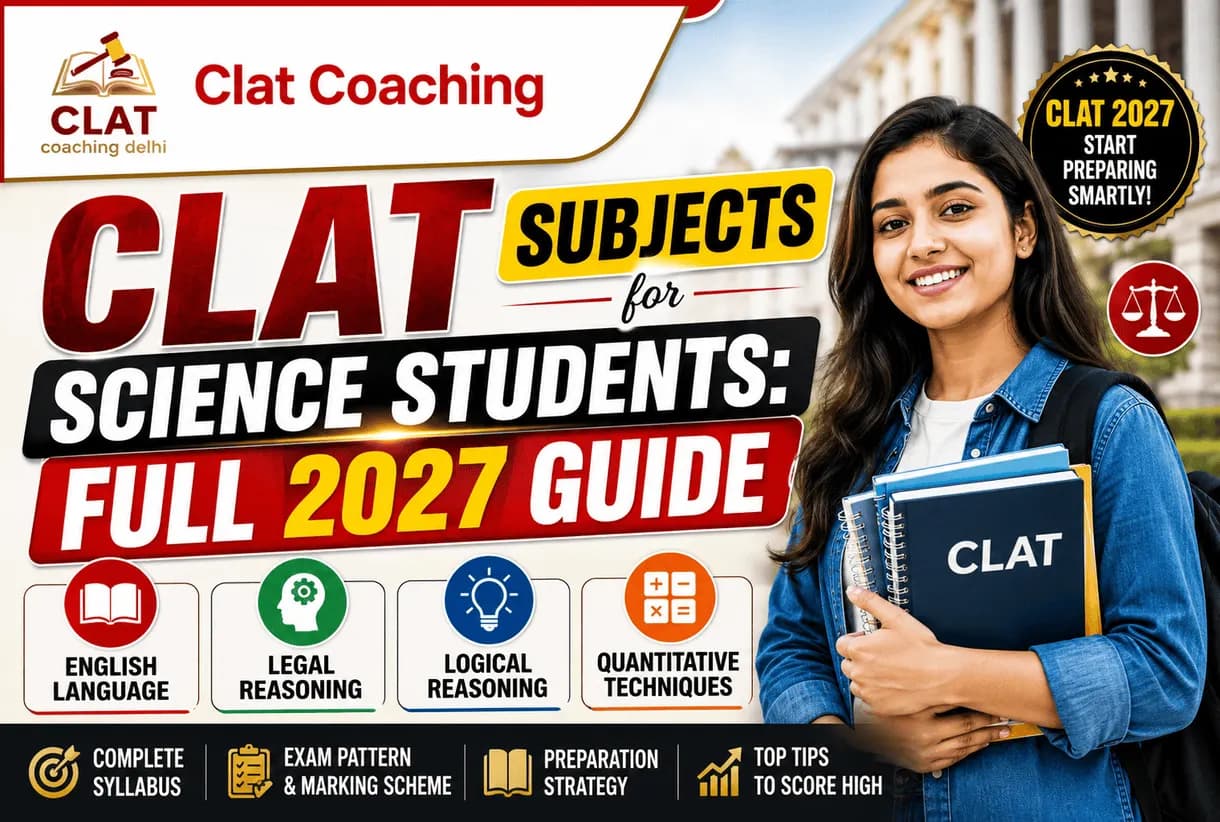
The most reassuring fact for every aspirant is that the CLAT subjects for science stream students are identical to those for commerce and arts students. There is no separate paper and no science based questions. The CLAT exam subjects for science students are designed to test skills, not stream specific knowledge, which levels the playing field completely.
CLAT has five subjects, and understanding these CLAT five subjects early helps you plan your preparation with clarity. The paper checks how well you read, reason, calculate and stay aware of the world around you. Because none of these depend on your class 11 and 12 stream, a science student starts on equal footing and, in some sections, with a clear head start. For a broader overview, our detailed guide to the CLAT exam subjects explains each area in depth.
Complete List of CLAT Five Subjects and Exam Pattern
Before diving into strategy, it helps to see the full CLAT subjects and exam pattern in one place. The undergraduate paper carries 120 questions worth 120 marks, to be solved in 2 hours. Each correct answer earns 1 mark, while 0.25 marks are deducted for every wrong answer. The table below shows the section wise structure that shapes the CLAT exam pattern for every candidate.
CLAT Section | Approx Questions | Approx Marks | Weightage |
English Language | 22 to 26 | 22 to 26 | About 20 percent |
Current Affairs including General Knowledge | 28 to 32 | 28 to 32 | About 25 percent |
Legal Reasoning | 28 to 32 | 28 to 32 | About 25 percent |
Logical Reasoning | 22 to 26 | 22 to 26 | About 20 percent |
Quantitative Techniques | 10 to 14 | 10 to 14 | About 10 percent |
Total | 120 | 120 | 100 percent |
As the table shows, Legal Reasoning and Current Affairs carry the highest weightage, while Quantitative Techniques is the smallest section. Understanding how marks are added and deducted is just as important as knowing the syllabus, so it is worth reviewing the complete CLAT marking scheme before you build your plan.
CLAT Eligibility for Science Students After 12th
A frequent worry is whether a science background creates any barrier. It does not. The CLAT eligibility for science students is exactly the same as for any other stream, because the Consortium of National Law Universities sets no stream restriction. If you have passed or are appearing for your 10 plus 2 examination, you qualify, which settles the question of whether science students can appear for CLAT.
You must have completed 10 plus 2 or an equivalent examination from a recognised board.
A minimum of about 45 percent marks is generally required for the general category, and about 40 percent for reserved categories, subject to the official notification.
Students appearing for their 12th board examination can also apply, making CLAT subjects for science students after 12th accessible right away.
There is no upper age limit, so both fresh and repeat aspirants are welcome.
Eligibility Criteria | Requirement for Science Students |
Stream allowed | Any stream, including PCM and PCB |
Qualifying exam | 10 plus 2 or an equivalent from a recognised board |
Minimum marks | About 45 percent general, about 40 percent reserved, per official notification |
Appearing students | Students awaiting 12th results can also apply |
Age limit | No upper age limit |
In short, the door is fully open. To confirm the exact cut offs and documents, review our detailed page on CLAT exam eligibility and always cross check the latest official notification.
Subject Wise Breakdown of the CLAT Syllabus for Science Students
Now let us look at what to actually study. This CLAT subject-wise syllabus for science students breaks each of the five sections into what it tests and how a science background can help. Building a clear picture of the CLAT syllabus for science students early prevents wasted effort and keeps your revision focused.
CLAT English Language Syllabus for Science Students
The CLAT English Language syllabus is built around reading comprehension. You will read passages of around 450 words and answer questions on the main idea, inference, tone and vocabulary. Since many science students read fewer long form texts during 11th and 12th, CLAT English preparation for science students should begin with daily reading. Strengthening CLAT reading comprehension for science students through newspapers, editorials and quality non fiction quickly closes this gap and also supports the Legal Reasoning section.
CLAT Current Affairs and General Knowledge for Science Students
The section on CLAT Current Affairs and General Knowledge tests awareness of national and international events, along with static general knowledge and legal developments. This is a fresh area for most science students, so CLAT current affairs preparation for science students must be consistent rather than last minute. Effective CLAT GK preparation for science students combines a daily newspaper habit with monthly current affairs compilations. Our structured guide to CLAT general knowledge preparation shows exactly how to build this awareness step by step.
CLAT Legal Reasoning Syllabus for Science Students
Here is the best news for science aspirants. The CLAT Legal Reasoning syllabus requires no prior knowledge of law. Each question gives you a legal principle and a set of facts, and you simply apply the principle logically to reach the answer. This makes CLAT legal reasoning for science students very approachable, because it rewards the same analytical thinking used in science and mathematics. With focused practice through resources like our legal reasoning preparation, science students often perform strongly in this high weightage section.
CLAT Logical Reasoning Syllabus for Science Students
The CLAT Logical Reasoning syllabus covers arguments, assumptions, analogies, patterns and critical reasoning. Science students, trained to think in cause and effect, usually adapt to this section naturally. Steady CLAT logical reasoning for science students practice, combined with broader CLAT reasoning preparation for science students, turns this into a reliable scoring area rather than a hurdle.
CLAT Quantitative Techniques Syllabus for Science Students
The CLAT Quantitative Techniques syllabus is based on class 10 level mathematics, covering arithmetic, percentages, ratios, averages and data interpretation. This is where a science background shines, since CLAT maths for science students feels far easier than the board level mathematics they have already mastered. Smart CLAT quantitative techniques preparation focuses on speed and data interpretation, and our set of data interpretation questions for CLAT gives targeted practice for this section.
Why Science Students Have a Natural Advantage in CLAT
Far from being a disadvantage, a science background offers real strengths in this exam. The table below maps where CLAT for science stream students can convert their existing skills into marks, and where they should invest extra effort.
CLAT Section | Advantage for Science Students | What to Build |
Quantitative Techniques | Strong maths and speed from board level study | Focus on data interpretation accuracy |
Logical Reasoning | Analytical, cause and effect thinking | Practice argument based questions |
Legal Reasoning | Principle application suits a logical mind | Learn to read principles carefully |
English Language | Fresh start, no prior disadvantage | Build daily reading comprehension |
Current Affairs and GK | Curiosity and memory from science study | Follow news and static GK daily |
The pattern is clear. Two of the five sections play directly to a science student strength, while the rest simply need consistent habit building. This is why so many aspirants succeed at CLAT without humanities background and go on to top National Law Universities.
CLAT Subjects for PCM Students and How to Prepare
Students from the Physics, Chemistry and Mathematics stream enjoy a particular edge. The CLAT subjects for PCM students are the same five sections, but their strong mathematical foundation makes Quantitative Techniques and Logical Reasoning feel comfortable from day one. Effective CLAT preparation for PCM students therefore shifts most energy toward English, Current Affairs and Legal Reasoning, where the learning curve is steeper. A PCM aspirant who reads daily and follows the news can build a very balanced score, and any lingering doubt about whether PCM students can apply for CLAT is quickly put to rest by the open eligibility rules.
CLAT Subjects for PCB Students and How to Prepare
Biology stream aspirants are equally well placed. The CLAT subjects for PCB students are identical, and the strong reading and memorisation habits developed in biology transfer beautifully to Current Affairs, General Knowledge and reading comprehension. For CLAT preparation for PCB students, the main focus should be gaining confidence in Quantitative Techniques, since PCB students may practise less mathematics in 11th and 12th. Regular numerical practice closes this gap fast, and just like their PCM peers, PCB students can apply for CLAT without any restriction.
The quick comparison below shows how each science stream can play to its strengths while planning preparation.
Preparation Aspect | PCM Students | PCB Students |
Natural strength | Mathematics and logical reasoning | Reading, memory and general knowledge |
Section to build first | English and current affairs | Quantitative techniques |
Legal reasoning fit | Suits logical, analytical thinking | Suits careful reading of principles |
Fastest scoring area | Quantitative techniques | Current affairs and general knowledg |
CLAT Preparation Strategy for Science Students
A clear plan turns potential into a rank. The following CLAT preparation strategy for science students is designed to use your strengths while steadily building newer skills. Strong CLAT preparation for science students always balances all five sections rather than over relying on comfort areas.
Start reading English editorials and long passages daily to build comprehension and speed.
Follow a newspaper and monthly current affairs digest to master awareness over time.
Practise legal reasoning by applying given principles to facts, without memorising any law.
Use your maths strength to score fast in Quantitative Techniques and data interpretation.
Take regular full length mock tests and analyse every error to refine your CLAT preparation for science stream.
CLAT Section | Priority for Science Students | Daily Practice Focus |
English Language | High | Reading comprehension and vocabulary |
Current Affairs and GK | High | Newspaper and monthly compilation |
Legal Reasoning | High | Applying principles to facts |
Logical Reasoning | Medium | Arguments and critical reasoning |
Quantitative Techniques | Medium | Data interpretation speed |
Consistent mock practice is the single biggest habit that separates top rankers from the rest. A reliable CLAT mock test series trains you to manage time and negative marking under real exam pressure.
Common Challenges Science Students Face and How to Overcome Them
Every strength comes with a matching area to watch. Recognising these challenges early makes them easy to solve.
Slower reading speed, solved by daily reading of editorials and long passages.
Limited current affairs habit, solved by a fixed daily news and revision routine.
Unfamiliarity with legal language, solved by steady principle based practice.
Over confidence in maths, solved by not neglecting the higher weightage sections.
None of these are stream specific weaknesses. They are simply new habits, and with the right mentorship they are built in a matter of months. Students who want a structured path often begin by exploring how to become a lawyer in India to stay motivated through the journey.
Smart Coaching Support for Science Students Preparing for CLAT
While self study works for some, most science students benefit from expert guidance that translates their analytical strengths into exam marks quickly. At Law Prep Tutorial, our CLAT 2027 programme is built to help students from every stream, with structured concept classes, sectional practice, and a rigorous test series aligned to the real exam. Classroom learners can join our Delhi NCR centres, including our flagship CLAT coaching in Hauz Khas, while outstation and working aspirants can access the same mentorship through our online CLAT coaching programme.
Before enrolling, many families like to compare options and understand the investment involved. You can review the transparent CLAT coaching fees, check the CLAT exam fees, and if you are still deciding, book a free counselling session with our mentors to map a plan around your science background. You can also learn more about our teaching team on the about Law Prep Tutorial page.
Key Takeaways for Science Stream Aspirants
CLAT has five subjects that are identical for every stream, with no science based questions.
Science students are fully eligible and often stronger in Quantitative Techniques and Logical Reasoning.
Legal Reasoning needs no prior law knowledge and suits an analytical, logical mind.
English and Current Affairs need daily habit building rather than special talent.
With a balanced plan, cracking CLAT without a humanities background is very achievable.
About the Author
This guide was written and reviewed by Anand Sharma, known to students as Anand Sir, Director and Academic Mentor at Law Prep Tutorial. A law graduate with a B.A. LL.B. from National Law Institute University Bhopal, he has mentored thousands of CLAT aspirants from science, commerce and arts backgrounds. The syllabus and pattern details here reflect the most recent CLAT editions and should always be cross checked with the latest official notification published by the Consortium of National Law Universities, which remains the final authority on CLAT subjects, eligibility and exam pattern.
Conclusion and Your Next Step Toward CLAT 2027 Success
The idea that law entrance is only for humanities students is simply a myth. The CLAT subjects for science students are the same five skill based sections everyone faces, and a science background brings genuine strengths in reasoning and numbers. With daily reading, steady current affairs, and confident legal reasoning practice, a science aspirant is fully equipped to top the exam.
If you are ready to turn your science strengths into a National Law University seat, let our mentors guide you. Explore our CLAT coaching programme, sharpen your accuracy with a proven CLAT mock test series, and take the first step today by booking your free counselling session with Law Prep Tutorial. Your CLAT 2027 success story can start right now.
Frequently Asked Questions
Yes, science students can appear for CLAT. The Consortium of National Law Universities places no stream restriction, so anyone who has passed or is appearing for 10 plus 2 in any stream, including science, is eligible to apply