
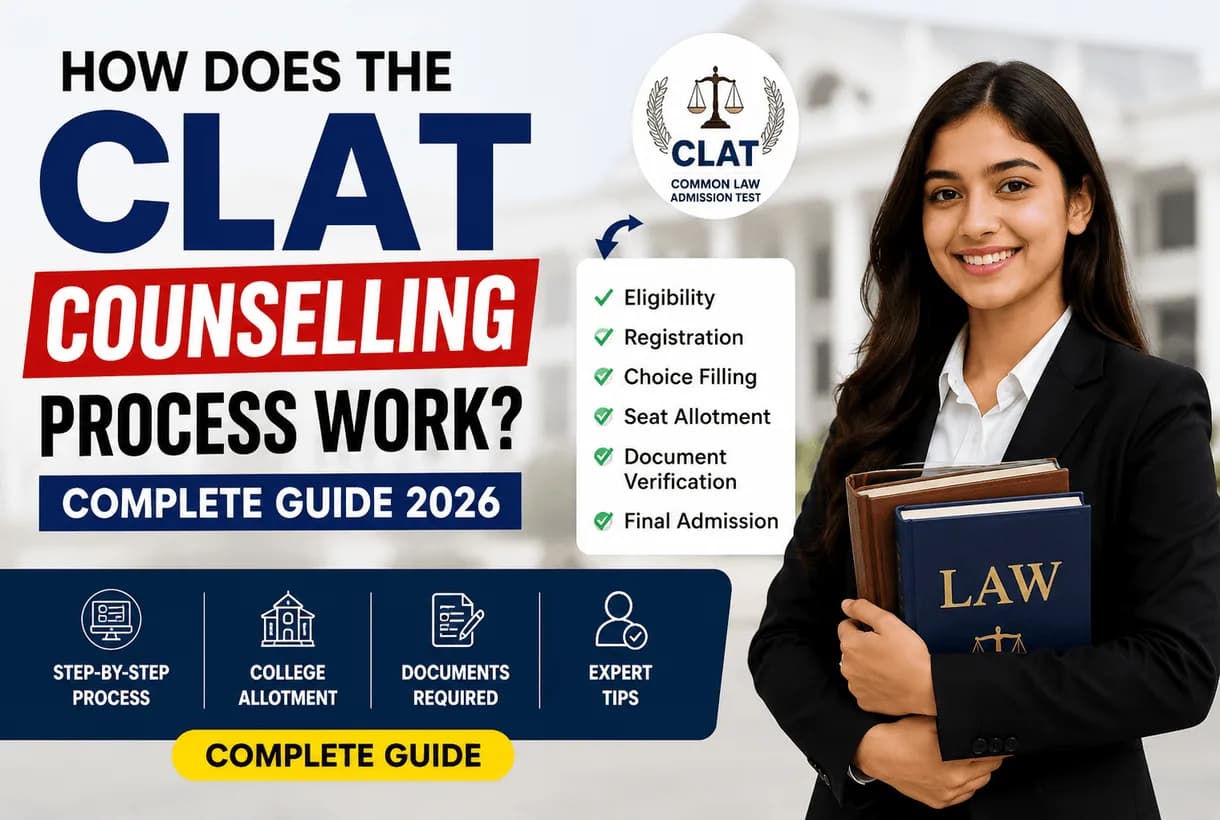
CLAT Counselling Process Explained Step by Step
For lakhs of law aspirants, clearing CLAT is only half the journey. The other half, often more confusing than the exam itself, is the CLAT counselling process, the stage where a rank on paper turns into an actual seat at a National Law University. Every year, students who scored well end up with a college that does not match their aspirations, not because of a weak rank, but because of an avoidable mistake during counselling, a missed deadline, an unclear preference list, or confusion between freeze, float and exit.
This guide breaks down the complete CLAT counselling process explained step by step, from registration to final admission, so you know exactly what to do and when to do it. It also covers the CLAT counselling fee structure, required documents, the difference between CLAT and AILET counselling, and how proper CLAT coaching in Delhi NCR online and offline can help you plan your preferences with more confidence, not less anxiety.
What CLAT Counselling Means and Why Every Candidate Must Understand It
CLAT counselling is the centralised seat allocation process conducted by the Consortium of National Law Universities after CLAT results are declared. Candidates who clear the qualifying rank register for counselling, pay the required fee, list their preferred NLUs in order, and are then matched to seats purely on the basis of All India Rank within their category.
Unlike a walk in admission, CLAT counselling is entirely online and merit driven. There is no interview and no separate application to individual NLUs at this stage, since the Consortium handles allotment for all participating law universities together. Understanding this process well in advance, ideally before your CLAT 2027 exam date and notification even arrive, gives you a real strategic advantage when it is time to rank your preferences.
CLAT Counselling Step 1, Registration on the Consortium of NLUs Portal
The first step in the CLAT counselling process is registration on the official Consortium portal at consortiumofnlus.ac.in. Candidates who meet the qualifying criteria receive an intimation through their registered email and phone number, after which they must log into their existing CLAT account and click the option to register for counselling.
Registration typically opens within days of the result declaration and stays open for a limited window, so candidates should check the portal regularly rather than waiting for a reminder. This is also the stage where many aspirants who prepared through structured CLAT coaching Delhi NCR online programmes already have a rough NLU shortlist ready, because their mentors would have discussed realistic options based on mock rank trends well before results were out.
CLAT Counselling Step 2, Paying the Registration and Category Wise Counselling Fee
Once registered, candidates must pay the counselling registration fee through net banking, debit card or credit card. The fee amount is category based, general, OBC, BC, EWS and PWD candidates typically pay a higher registration fee compared to SC and ST candidates, who pay a discounted amount as per Consortium policy.
This payment must be completed within the counselling registration window, since an incomplete payment usually means the candidate is not considered for the first allotment list. Keep a screenshot or downloaded receipt of every payment made during counselling, since it becomes useful evidence in case of any portal error or grievance later in the process.
CLAT Counselling Step 3, Filling and Locking Your NLU Preference List
This is the most decisive step in the entire CLAT counselling process. After payment, candidates must list every NLU they are willing to join, arranged strictly from most preferred to least preferred. Experts generally recommend listing at least fifteen NLU preferences rather than only two or three, because a short list can leave a good rank holder with no seat at all if the top few choices are extremely competitive that year.
One rule catches many students off guard, once the preference list is locked for the counselling cycle, it usually cannot be edited or reordered in later rounds, only upgraded automatically if you choose the float option. This is why preference planning should ideally happen before results, using historical cutoff trends as a reference point, not after the first allotment list is already out.
CLAT Counselling Step 4, Seat Allotment Rounds and the Merit Based Matching Logic
Seat allotment in CLAT counselling is conducted across multiple rounds, generally five, spread from soon after results in December or January through to May. The system first arranges all candidates by All India Rank within their category, then processes each candidate's preference list from the top, matching them to the highest ranked NLU on their list where a seat is still available.
Candidates who do not receive a seat in the first list automatically carry forward into subsequent rounds without needing to reapply. Every published list comes with a fixed response window during which the candidate must act, missing this window without exercising any option can result in the seat being forfeited entirely, so calendar reminders around every list release date are essential.
CLAT Counselling Step 5, Choosing Freeze, Float or Exit After Every Allotment List
Once a seat is allotted, every candidate must choose one of three options within the deadline.
What Freeze Means in CLAT Counselling
Freeze means the candidate accepts the allotted NLU and exits the process happily with that seat confirmed. This is the right choice once you are genuinely satisfied with the college on offer.
What Float Means in CLAT Counselling
Float means the candidate accepts the current seat as a safety net but wishes to be considered for a better preference in the next round, retaining the current allotment while waiting for an upgrade. This option requires ongoing attention, since terms can vary by year.
What Exit Means in CLAT Counselling
Exit means the candidate withdraws from counselling entirely, usually because they plan to join a different law college or attempt CLAT again the following year.
Confirmation Fees and Common Freeze Float Mistakes
Choosing Freeze or Float requires payment of a confirmation fee, generally around Rs 20000, within the response window. Choosing incorrectly is one of the costliest mistakes in CLAT counselling, floating without understanding that a lower ranked seat can sometimes be lost if the algorithm reassigns it, or freezing too early without checking if a genuinely better option was realistically within reach.
CLAT Counselling Step 6, Document Verification and Final Admission at the NLU
After freezing or floating into a confirmed seat, the final stage is document verification and admission at the allotted NLU. Candidates must upload or physically submit documents proving identity, academic eligibility and category status, following which the NLU issues an admission or offer letter. The candidate then pays the remaining university specific fee, which varies from one NLU to another, through online transfer, demand draft or the payment mode specified by that university.
Reporting to the allotted NLU within the specified date is compulsory, missing this final reporting deadline even after freezing a seat can lead to cancellation and forfeiture of fees already paid, so this step should never be treated as a formality.
CLAT Counselling Fees Structure Explained Category Wise
The CLAT counselling fee typically has two components, a registration fee paid at the start of counselling and a confirmation fee paid only if a seat is allotted and accepted through freeze or float.
Counselling Registration Fees by Category
General, OBC, BC, EWS and PWD category candidates usually pay a higher registration fee compared to SC and ST candidates, who receive a fee concession as per Consortium rules.
Confirmation Fee After Seat Allotment
The confirmation fee of around Rs 20000 applies uniformly once a candidate chooses freeze or float, and is separate from the university admission fee charged later by the individual NLU. Because exact figures can be revised each year, always cross check the current fee notification on the official Consortium website before making any payment, rather than relying only on last year's numbers.
CLAT Counselling Schedule, Number of Rounds and Typical Timeline
CLAT counselling generally runs across five rounds starting soon after the result declaration and continuing until vacant seats are filled, typically stretching from December or January through to May. Each round has its own registration or response window, usually opening around 10 AM and closing around 1 PM on the final day, so last minute submissions carry real risk if the portal experiences heavy traffic near the deadline.
The final rounds, usually the fourth and fifth, are conducted mainly to fill seats left vacant after earlier candidates failed to pay the university fee on time. After the fifth round closes, the centralised admission process ends, though individual NLUs may still admit candidates against any remaining vacancies through their own separate norms.
Documents Required for CLAT Counselling Registration and Reporting
Every candidate should keep scanned and physical copies of key documents ready well before counselling begins.
Documents Checklist for CLAT Counselling
This typically includes the CLAT admit card and scorecard, class 10 marksheet for date of birth proof, class 12 marksheet for eligibility confirmation, transfer certificate or school leaving certificate, caste certificate for SC, ST or OBC candidates, and a domicile certificate where state level seats are being claimed.
Avoiding Document Mismatch Delays
Uploading clear, correctly named files avoids delays during verification, and any mismatch between documents, such as a name spelled differently on the marksheet and the CLAT application, should be corrected or clarified with the Consortium well in advance rather than discovered on the day of reporting.
Common Mistakes Candidates Make During CLAT Counselling
Short Preference Lists and Misunderstanding Float
The most common error is listing too few NLU preferences, which can leave a genuinely good rank without any seat if the shortlisted colleges are unusually competitive that year. A close second is misunderstanding float, many candidates float expecting only upward movement, without realising the terms under which an allotted seat can change.
Missed Deadlines and Document Errors
Missing a response deadline, submitting the confirmation fee late, uploading unclear or mismatched documents, and failing to report physically within the specified window are the other repeat offenders every year. Most of these mistakes are entirely avoidable with a clear month by month checklist, which is exactly the kind of guidance structured mentorship during CLAT coaching Delhi NCR online sessions is built to provide.
CLAT Eligibility Criteria Every Counselling Candidate Should Confirm
Before counselling begins, candidates should reconfirm their CLAT eligibility for the specific course applied to. For the five year integrated LLB programme, candidates generally need a minimum aggregate score in class 12 or equivalent, with a relaxed minimum for SC, ST and PWD categories, and there is usually no fixed upper age limit. For the LLM programme, an LLB or equivalent degree with a minimum aggregate score is required.
Eligibility is verified again during document checking at the NLU, so any doubt about category certificates, marksheet discrepancies or equivalence of a non standard qualifying degree should be resolved with the Consortium helpdesk before the counselling window closes, not after a seat has already been allotted.
CLAT Exam Pattern and Syllabus 2027 in Brief
Understanding the CLAT exam pattern helps put the counselling rank in context.
CLAT Exam Pattern Overview
CLAT is a two hour, largely passage based test covering five sections, English Language, Current Affairs including General Knowledge, Legal Reasoning, Logical Reasoning and Quantitative Techniques, with 120 objective questions built around comprehension rather than rote recall, carrying one mark each with 0.25 marks deducted for a wrong answer.
CLAT Syllabus 2027 Weightage
The CLAT syllabus 2027 keeps this same passage based philosophy, with English carrying around 22 to 26 percent weight, General Knowledge around 25 to 28 percent, Legal Reasoning around 25 to 30 percent, Logical Reasoning around 22 to 25 percent and Quantitative Techniques around 8 to 12 percent.
Why Rank Reflects Comprehension Practice
Since the pattern rewards reading speed and reasoning under time pressure rather than memorised content, your final counselling rank is really a reflection of consistent comprehension practice built over months, which is why serious aspirants track the official notification early and structure their preparation calendar around it rather than starting a few weeks before the exam.
CLAT 2027 Exam Date and Notification Timeline
Expected CLAT 2027 Timeline From Notification to Counselling
CLAT 2027 is expected to be held on 6 December 2026, a Sunday, from 2 PM to 4 PM, in offline pen and paper mode conducted by the Consortium of NLUs. The official notification is expected in July 2026, with registration confirmed to open in August 2026 and the application window likely closing around the end of October 2026. The admit card is expected in the third week of November 2026, the result in the third week of December 2026, and counselling is expected to begin in late December 2026.
Why These Dates May Still Change
All of these dates remain expected rather than final until the Consortium publishes the official CLAT 2027 notification, so candidates planning their counselling preparation around this timeline should keep checking the detailed CLAT 2027 exam date and notification page at clatcoachingdelhi.com for updates as soon as the Consortium confirms them.
CLAT vs AILET Counselling, Key Differences Explained
CLAT and AILET are separate examinations with separate counselling processes, and confusing the two is a common mistake among first time aspirants. CLAT vs AILET differs first in scope, CLAT counselling covers seat allotment across the participating NLUs through the Consortium portal, while AILET counselling is conducted independently by NLU Delhi for its own seats only, since NLU Delhi does not accept CLAT scores.
The two exams also differ in pattern, difficulty level and cutoff behaviour, AILET traditionally has a distinct question philosophy from CLAT rather than a diluted overlap. Aspirants targeting both should prepare in exam specific batches rather than one blended course, since strategy, time management and even the counselling calendar for each exam run on separate timelines.
Why CLAT Previous Year Papers Still Matter After the Exam Is Over
Most aspirants stop referring to CLAT previous year papers the moment the exam is done, but they remain useful right through counselling.
Which CLAT Previous Year Papers to Prioritise
Papers from 2024 to 2026 match the current 120 question, passage based pattern and are the most reliable reference, papers from 2020 to 2023 followed a 150 question version of the same style and still offer strong practice value, while anything before 2020 used an older 200 question, knowledge heavy format that no longer reflects the exam candidates actually sit today.
Using Cutoff Trends to Plan Your Preferences
Studying how cutoff ranks for specific NLUs moved across these current format years helps you judge whether a particular preference is realistic this year or overly ambitious. This historical view is especially useful while deciding between freeze and float, if a candidate's rank sits close to a recent year's cutoff for a higher preference NLU, floating for one more round may be a reasonable calculated risk rather than a blind gamble. A detailed year wise breakdown of which CLAT previous year papers to prioritise and how to analyse them is available on the previous year papers guide at clatcoachingdelhi.com.
How the Right CLAT Coaching Support Helps During Counselling Decisions
While counselling itself is a portal driven, rule based process, the decisions around it, how many NLUs to list, whether to freeze or float, how to interpret a borderline rank, are where good mentorship genuinely changes outcomes. Structured CLAT coaching Delhi NCR online and offline programmes typically include rank predictor sessions, previous year cutoff analysis and one on one mentor calls specifically during the counselling window, not just during exam preparation.
This kind of support matters because counselling decisions are made under time pressure, often within a 48 to 72 hour response window, and a mentor who has tracked hundreds of past allotment cycles can help a student avoid an emotional, rushed choice that a calmer, data backed conversation would have prevented.
About Law Prep Tutorial, CLAT Coaching Delhi NCR Online and Offline
Law Prep Tutorial Delhi NCR has been preparing CLAT and AILET aspirants for over 17 years, since 2009, with more than 1310 confirmed NLU selections across its four Delhi NCR centres at Hauz Khas, GTB Nagar, Noida and Gurugram. The institute runs exam specific silos, a dedicated CLAT 2027 coaching track and a separate AILET 2027 track, rather than one diluted combined batch, so that legal reasoning, logical reasoning, English, current affairs and quantitative techniques each get focused, sequenced attention.
Classes are taught by named NLU alumni faculty, including Anand Sir, an NLIU Bhopal graduate who specialises in Critical Reasoning, Priyam Ma'am, who leads General Knowledge and Current Affairs, and Eikluvya Sir, who focuses on Legal Reasoning, supported by a rank graded mock series of over 100 full length tests with section wise analytics after every attempt. Both one year and two year programmes are available, along with a fully live online CLAT coaching Delhi NCR track for aspirants outside the NCR region, using the same faculty, material and mock ecosystem as the offline batches. With CLAT 2027 expected on 6 December 2026, students who begin structured preparation early give themselves the maximum runway to build the comprehension speed that both the exam and, eventually, a confident counselling strategy require.
Conclusion and Next Step for CLAT Aspirants
The CLAT counselling process explained step by step above comes down to six stages that repeat every year, registration, fee payment, preference filling, merit based allotment, the freeze float exit decision, and final document verification with admission. None of these steps are individually difficult, but each one carries a hard deadline, and a single missed window can cost a candidate the NLU seat their rank had actually earned.
If you are preparing for CLAT 2027 or already have a scorecard in hand and are unsure how to plan your NLU preference list, Law Prep Tutorial Delhi NCR offers a free counselling and demo session across its Hauz Khas, GTB Nagar, Noida and Gurugram centres, as well as live online batches for students outside Delhi NCR. Call 8750581505 or visit clatcoachingdelhi.com to speak with a mentor and build a preference strategy backed by 17 years of verified NLU selection data, not guesswork.
Frequently Asked Questions
The CLAT counselling process is the centralised seat allocation system run by the Consortium of NLUs after CLAT results are declared. Candidates register online, pay the counselling fee, list NLU preferences in order, and are matched to seats purely by All India Rank within their category across multiple allotment rounds, ending with document verification and admission at the allotted university.