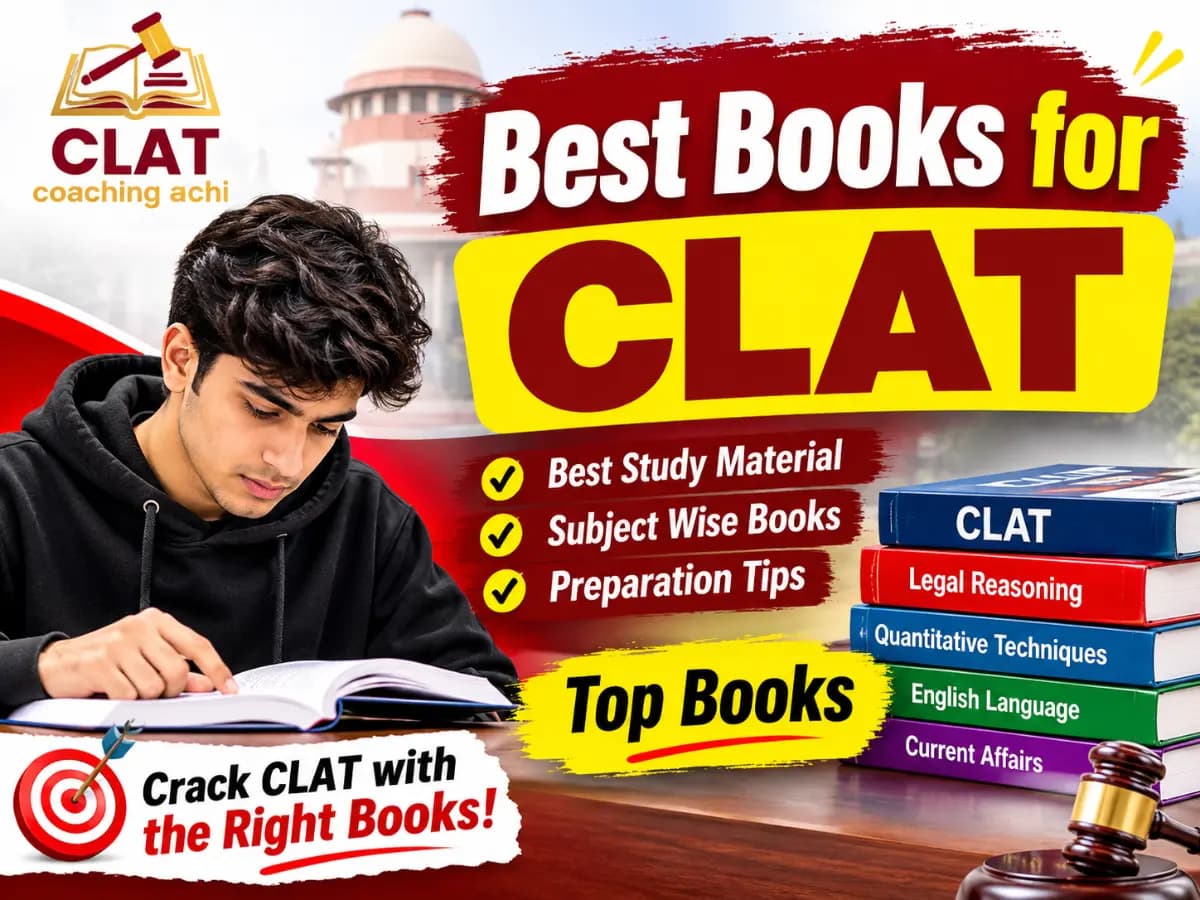
There is no single best book for CLAT. It is a five section exam, so you need a different book for each section. If you want to buy only three books, get these three. The first is Universal’s Guide to CLAT and LLB Entrance Examination, which gives you a base for the full syllabus. The second is A.P. Bhardwaj’s Legal Awareness and Legal Reasoning, which is the most important book for the Legal section. The third is Norman Lewis’s Word Power Made Easy, which is the best for English vocabulary. Everything else is extra on top of these. If you also want guidance along with the right books, options like CLAT coaching in Delhi NCR or CLAT coaching in Hauz Khas help you set both your book plan and your strategy. On this page we give you the full list of the best CLAT books for each section, so you do not get lost among the many books in the market.
One thing to note. The next CLAT exam (CLAT 2027) is expected on 6 December 2026. Please confirm the final date on the official website of the Consortium of NLUs. Whenever you buy any book, buy only the latest edition, because older editions can carry the wrong syllabus and pattern.
First understand the CLAT pattern, then buy the book
Many students simply Google the best book, buy ten books, and later find out that half of them were of no use. That is why the right direction at the start matters, whether you are preparing on your own or taking help from a centre like CLAT coaching in GTB Nagar and CLAT coaching in Noida. Before the list, understand the CLAT pattern in 30 seconds, because the best book is the one that matches this pattern.
CLAT is an offline exam taken with pen and paper on an OMR sheet. It has 120 MCQ questions and the whole paper is of 120 marks. You get a full 2 hours. Every correct answer gives you 1 mark and every wrong answer takes away 0.25 mark. A question you leave blank costs you nothing. There are five sections. English, GK and Current Affairs, Legal Reasoning, Logical Reasoning, and Quantitative Techniques. Every section is passage based, which means a paragraph comes first and the questions sit on top of it.
The marks are divided across sections roughly like this.
Current Affairs and GK is the biggest section. About 28 to 32 questions and around 25 percent weight.
Legal Reasoning is also about 28 to 32 questions, around 25 percent.
English Language has 22 to 26 questions, around 20 percent.
Logical Reasoning has 22 to 26 questions, around 20 percent.
Quantitative Techniques is the smallest. Only 10 to 14 questions, around 10 percent.
Two things become clear from this. First, Legal and GK together make up half the paper, so give the most attention to the books for these two. Second, CLAT is no longer a rote learning exam. Every section is passage based, which means you read a long paragraph and pull the answer out of it. So the best book is the one that has passage based practice questions, not just theory. If you keep this in mind, you will not end up among the people who buy the wrong books.
How to choose the best book for CLAT (5 simple rules)
Before buying books, check these five things. This small checklist will save you both money and time.
It should be the latest edition. The CLAT pattern changed in 2020 and in 2024 the questions were reduced from 150 to 120. An old book will carry the old pattern.
It should have passage based practice. Theory alone is not enough, the book should have reading comprehension type questions.
It should come with solutions. Without solutions you cannot understand your own mistakes, so pick a book with explanations.
It should be from a good publisher. Names like Universal, Arihant, Pearson, Oswaal and A.P. Bhardwaj are trusted. Stay away from random local guides.
It should include previous year papers, or buy them separately. The real CLAT papers after 2020 are more useful than any book.
In one line, latest edition, passage based, solved, and a good publisher, that is the formula for the best books.
If you want to buy only 3 books
The biggest mistake new students make is the belief that more books mean better preparation. The truth is the opposite. Toppers usually stick to four or five books and the previous papers, and they read them again and again. If you are just starting, begin with these three.
Universal’s Guide to CLAT and LLB Entrance Examination. A base for the full syllabus, all sections in one place.
A.P. Bhardwaj’s Legal Awareness and Legal Reasoning. The heart of the Legal section, which carries the most marks.
Norman Lewis’s Word Power Made Easy. For English vocabulary and understanding of words.
Add the CLAT previous year papers and one good current affairs magazine to these. That is your core ready. The section wise books are given below. Add a specific book only when you need more practice in that one section.
Section Wise Best Books for CLAT
Now let us look at each section in a little detail. For each section we have given the most recommended books, and also told you which one to pick and when.
1. Best books for English Language
The CLAT English section is based on reading comprehension, vocabulary, grammar and understanding. Rote learning does not work here. What works the most is the habit of reading.
Look at these books.
Norman Lewis’s Word Power Made Easy. The most popular book for vocabulary.
Wren and Martin’s High School English Grammar and Composition. To make your grammar base strong.
Chetananand Singh’s English is Easy. For exam type English practice.
Barron’s Pocket Guide to Vocabulary. For quick revision.
There is also one good free practice. Read an editorial from The Hindu or The Indian Express every day. The CLAT English passages are of this same level. It is free and works better than any book.
One small tip. Do not stuff four books into English. One vocabulary book, one grammar book and a daily newspaper, that is enough.
2. Best books for Current Affairs and General Knowledge
By marks this is the biggest section, and this is the place where people lose marks, because they study it at the last minute. The CLAT GK is mostly based on the current affairs of the last one year, with static GK a bit less.
Look at these resources.
Manorama Yearbook. Reliable for static GK and the big news of the year.
Lucent’s General Knowledge. For the base of static GK.
A good monthly current affairs magazine. This is the most useful one.
A newspaper, like The Hindu or The Indian Express. This is a must for daily current affairs.
One small tip. For GK, do one thing the most. Thirty minutes of newspaper every day and one monthly current affairs PDF. Do this all year and GK will become your strongest section in the exam.
3. Best books for Legal Reasoning, and legal aptitude books
Legal Reasoning is also around 25 percent and this section is what sets CLAT apart from other exams. The good news is that you need no prior legal knowledge. The rule is given in the passage and you simply have to apply it. You only need practice.
Students who are looking for legal aptitude books should look at this section. In the old pattern it was called Legal Aptitude, now it is called Legal Reasoning, but the books are largely the same.
Look at these books.
A.P. Bhardwaj’s Legal Awareness and Legal Reasoning. The most recommended book for the Legal section, from beginner to advanced.
Universal or LexisNexis Student Guide to CLAT. A very good source for the passage based questions of Legal.
R.K. Gupta’s Legal Aptitude for CLAT, from Arihant. A good legal aptitude book for extra practice.
One small tip. In Legal, spend more time on passage practice than on theory. The more legal passages you solve, the more your speed and accuracy grow.
4. Best books for Logical Reasoning
Logical Reasoning is around 20 percent. It has critical reasoning, arguments, assumptions, analogies and pattern based questions. In CLAT this too is passage based, which means logic questions on top of a paragraph.
Look at these books.
B.S. Sijwali’s A New Approach to Reasoning, from Arihant. Solid for both concept and practice.
R.S. Aggarwal’s Verbal and Non Verbal Reasoning. A classic for every type of question.
501 Challenging Logical Reasoning. If you only want good practice.
One small tip. In Logical Reasoning, focus more on critical reasoning, because that is what comes the most in CLAT, with fewer pure puzzles.
5. Best books for Quantitative Techniques
Quant is the smallest section, only 10 to 14 questions, and the level is maths up to Class 10. It has data interpretation, percentage, ratio, average and basic algebra. So you do not need heavy books here.
Look at these books.
R.S. Aggarwal’s Quantitative Aptitude. A standard book for base and practice.
NCERT Class 9 and 10 Maths. To make the base strong, free and best.
M. Tyra’s Quicker Maths. For speed and shortcuts, if you have the time.
One small tip. Do not memorise the whole of R.S. Aggarwal in Quant. Do only the CLAT topics, like DI, percentage, ratio, average and time and speed. Do not spend 6 months for 10 marks.
Why the Universal Guide to CLAT deserves a separate mention
People who search for universal guide to clat, universal clat book, clat universal book or universal clat guide are actually looking for one famous book. It is Universal’s Guide to CLAT and LLB Entrance Examination, published by LexisNexis.
Why is it so popular. Here are a few reasons.
The full syllabus in one place. All five sections, that is English, GK, Legal, Logical and Quant, in one book.
Solved previous papers. The old CLAT and AILET papers with solutions.
A strong legal section. For legal reasoning its answers and explanations are considered reliable.
A good start for beginners. If you are just starting and want an overall idea from one book, this is the best starting point.
But understand one thing clearly. The Universal guide is a very good starting book, but not enough on its own. Use it as a base and add the section book above for the section you are weak in. There is nothing like cracking CLAT from one book. The Universal guide is no exception to this.
CLAT Books 2027, what is new this year
For the students searching for clat books 2027, here is the clear picture.
There is no big change in the pattern. The Consortium has said the syllabus and pattern will stay like last year, that is 120 questions and passage based. So any standard book in the latest edition will work.
The new thing is in the edition, not the book. New editions add fresh current affairs and new solved papers. So do buy the latest edition for GK and previous paper books.
The concepts in Legal, Logical and Quant stay the same. If you have a good book that is one or two years old in these, just add the new papers to it. There is no need to buy a whole new book.
In short, a new year means fresh current affairs and fresh papers, not a whole new set of books. Spend money where the content has actually changed.
Books alone are not enough, you also need strategy
Good books are important, but books alone do not get you a rank. These things should go along with the books.
Previous year papers. More important than any book. CLAT got its passage based pattern in 2020, so focus only on the papers after 2020.
Mock tests. One full mock every week. This builds the speed and the temperament for the real exam.
Revision notes. Make a short note of what you read. This is what helps right before the exam, you do not read the whole book again.
The habit of reading. English and Legal are both passage based, so reading a newspaper every day helps in both.
One simple rule. Give 70 percent of your time to practice and revision and 30 percent to reading new things. Most beginners do the opposite and fall behind in rank.
Common mistakes people make while buying books
Buying too many books. Instead of keeping 15 books, it is better to read five books five times.
Buying an old edition because it is cheaper online. This makes the pattern and current affairs outdated.
Buying only theory books and skipping the practice questions.
Dropping English out of fear. The English section is passage based, do not run from it. A daily newspaper slowly improves it.
Leaving GK and current affairs for the last. This is the biggest section and it needs consistency all year.
A special note for Hindi medium students
If you are from a Hindi medium background and are searching for the best book for CLAT because you are scared of English books, do not worry. Understand a few things.
The official medium of CLAT is English, so you will have to prepare from English books. There is no shortcut, but it is doable.
Start with vocabulary and a daily newspaper. First read the headlines, then short articles, then editorials.
The concepts in Legal, Logical and Quant run on logic. They ask for understanding more than language, so Hindi medium students are often strong here.
Read every day for six to eight months. The fear of English slowly turns into confidence.
If you are in NCR and want a class that explains in Hindi, CLAT coaching in Ghaziabad and CLAT coaching in Gurugram centres offer step by step mentoring for beginners, from choosing books to mock test strategy.
Frequently Asked Questions
There is no single best book, because CLAT is a five section exam. If you must pick one, Universal’s Guide to CLAT and LLB Entrance Examination is the best overall base, but you still have to add section books to it.