
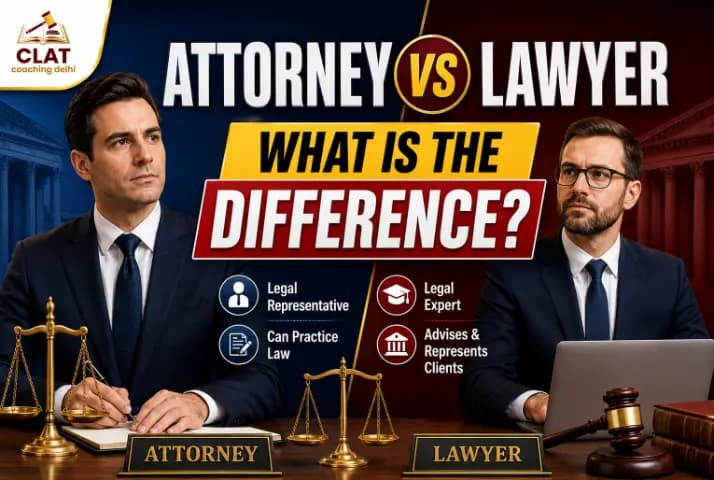
A lawyer is anyone with a law degree; an attorney, short for attorney at law, is a lawyer who has passed the bar exam and is licensed to represent clients in court. All attorneys are lawyers, but not all lawyers are attorneys, explains Law Prep Tutorial Delhi NCR.
Planning a law career? WhatsApp us | Call +91 8750581505
People use attorney and lawyer as if they mean the same thing, and most of the time that is fine. In the strict sense they are not identical, and the difference is worth knowing whether you are hiring one or planning to become one. This guide from Law Prep Tutorial Delhi NCR settles the difference between an attorney and a lawyer in plain words, explains what attorney at law really means, shows how the words change from one country to the next, and tells Indian readers which term applies to them.
What is a lawyer?
A lawyer is anyone who has studied law and holds a law degree, such as a Juris Doctor in the United States or an LLB in India and the United Kingdom. A lawyer can research the law, give advice and draft documents. Having the degree makes you a lawyer, but it does not automatically give you the right to stand up in court and represent a client. For that, most systems require a further licence.
What is an attorney?
An attorney, in full an attorney at law, is a lawyer who has passed the bar exam and holds a licence to practise law in a particular jurisdiction. That licence is what lets an attorney represent clients in court, file legal documents and act on a client's behalf. In the United States the word attorney usually signals a practising, licensed lawyer, which is why every attorney is a lawyer while not every lawyer is an attorney.
Attorney vs lawyer: the difference at a glance
Basis | Lawyer | Attorney |
Meaning | A holder of a law degree | A lawyer licensed to represent clients in court |
Qualification | Law degree, such as a JD or LLB | Law degree plus passing the bar exam |
Right to appear in court | Not by the degree alone | Yes, once licensed |
Full form | None | Short for attorney at law |
Everyday US usage | General term for a legal professional | Usually a practising, licensed lawyer |
Rule of thumb: all attorneys are lawyers, but not all lawyers are attorneys.
Is an attorney the same as a lawyer?
Not exactly. The two overlap, and in casual American speech they are used interchangeably, but the precise line is the licence to practise. A person who has a law degree but has not passed the bar is a lawyer and not yet an attorney. Once they pass the bar and are admitted, the same person is an attorney. So attorney is the narrower, licensed subset of lawyer.
Where do the words come from?
The two words arrived by different routes, which is why they carry slightly different senses. Attorney comes from an old Anglo-Norman word meaning one who is appointed to act for another, so it has always carried the idea of acting on someone's behalf. Lawyer is the plainer word for a person learned in the law. That history is why attorney still implies representation and authority, while lawyer simply describes training.
Attorney at law vs attorney in fact
This is where many people get confused, because attorney has a second, non-lawyer meaning.
Attorney at law: a licensed legal professional who can represent you in court. This is the meaning people usually intend.
Attorney in fact: a person you authorise through a power of attorney to act for you, for example to sign documents or manage money. An attorney in fact needs no law degree and cannot represent you in court unless they are also an attorney at law.
So the phrase power of attorney refers to an attorney in fact, not to a courtroom lawyer.
What do these titles mean around the world?
The biggest source of confusion is that different countries use different words for the same work. Here is how the main terms line up.
Country | Common terms | Notes |
United States | Attorney, lawyer | Used interchangeably; attorney means licensed to practise |
United Kingdom | Solicitor, barrister | Solicitor advises and prepares; barrister argues in higher courts |
India | Advocate, lawyer | Attorney appears mainly in power of attorney and Attorney General |
South Africa | Attorney, advocate | Attorney is client-facing; advocate argues in court |
Australia | Solicitor, barrister, lawyer | Lawyer is used broadly for both roles |
Canada | Lawyer, attorney | Barrister and solicitor titles are also used |
For the Indian picture in full, including how an advocate differs from an attorney, see our guide to the difference between an advocate and an attorney in India.
Related terms: counsel, esquire, solicitor, barrister, advocate
Counsel: a lawyer who advises or represents a client in a specific matter; in-house counsel works inside a company.
Esquire (Esq.): an honorific written after the name of a practising attorney, mainly in the United States.
Solicitor and barrister: the British split, where a solicitor advises and a barrister argues in the higher courts.
Advocate: the Indian and South African word for a lawyer qualified to argue in court, the closest equivalent of a US attorney.
What does this mean in India?
In India, the equivalent of a US attorney is an advocate. An advocate is a law graduate who has cleared the All India Bar Examination and enrolled with a State Bar Council, which allows them to appear in court. Indians rarely use the word attorney in daily practice; you will mostly meet it in the phrase power of attorney and in the office of the Attorney General of India. So if a US page says attorney and you are in India, read it as advocate.
In our counselling sessions at Law Prep Tutorial Delhi NCR, this is the single most common terminology mix-up we clear up for new aspirants: an Indian court lawyer is an advocate, not an attorney.
Thinking about law after Class 12? The route to becoming an advocate starts with the Common Law Admission Test. Check the CLAT eligibility and exam pattern, or WhatsApp us for a free counselling call.
Which word should you use?
If you are in the United States, use attorney for a licensed lawyer who can represent you, and lawyer as the general term. In the United Kingdom or Australia, ask for a solicitor or a barrister. In India, use advocate for a court lawyer and lawyer as the broad word. When in doubt, lawyer is understood everywhere; attorney is the safer word only where the law itself uses it.
Frequently Asked Questions
A lawyer is anyone with a law degree. An attorney, short for attorney at law, is a lawyer who has passed the bar exam and is licensed to represent clients in court. All attorneys are lawyers, but not all lawyers are attorneys.