
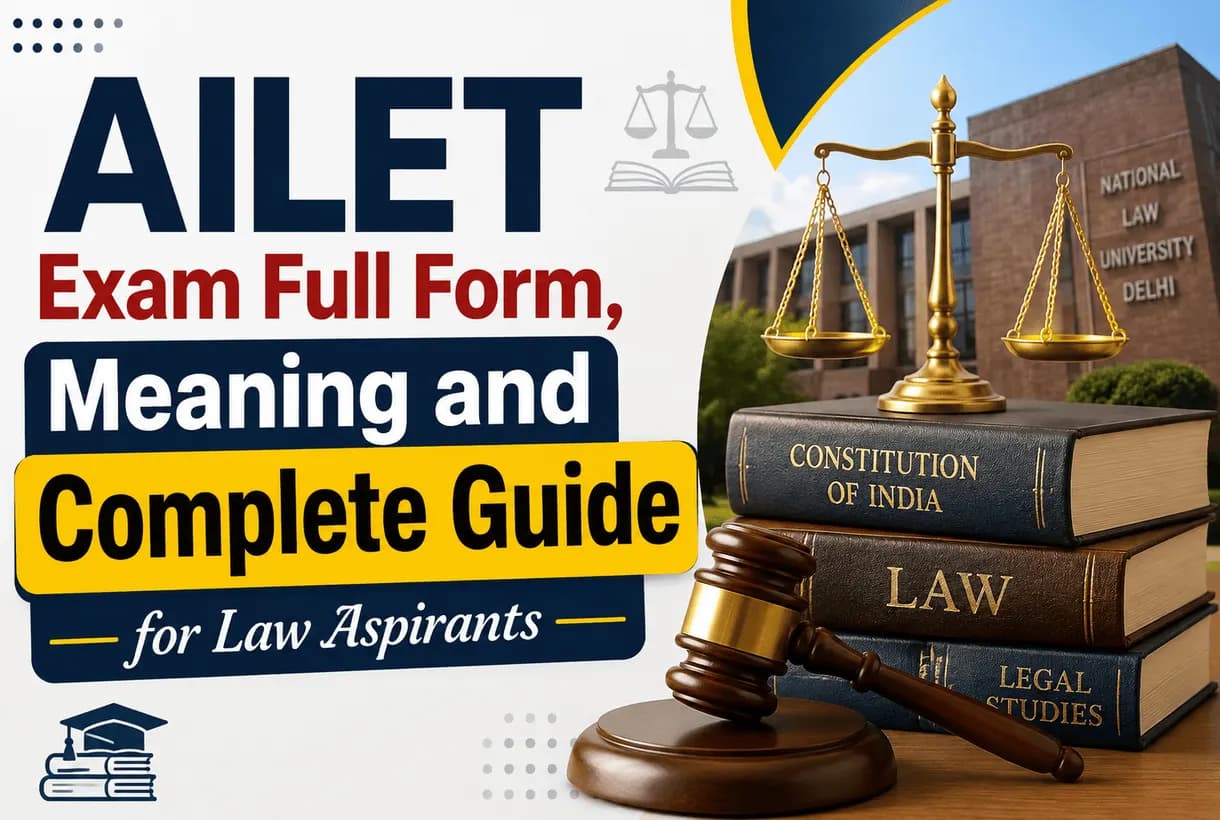
If you are exploring law entrance exams in India, one of the first things you will want to understand is the AILET exam full form and what the exam is really about. At our CLAT coaching in Delhi, we guide aspirants through every national law entrance, and AILET is one that often confuses beginners because it stands apart from the common test taken by most law schools. This guide explains the meaning of AILET, who conducts it, the eligibility, the exam pattern, the syllabus, important dates, the admission process, and how it differs from CLAT. NLU Delhi is consistently ranked among the top National Law Universities in India, which is why competition for its seats is intense.
AILET Exam Full Form and What It Stands For
The AILET exam full form is the All India Law Entrance Test. Each part of the name explains the exam. It is All India because candidates from across the country appear for it, it is a Law Entrance test because it decides admission to a law programme, and it is a single national Test conducted once a year. When people ask what the AILET exam is, the simplest answer is that it is the entrance exam for National Law University Delhi.
Full form: AILET stands for All India Law Entrance Test, the entrance exam conducted by National Law University Delhi for its undergraduate and postgraduate law programmes. |
Meaning of the AILET Exam and the University Behind It
The AILET exam is conducted by National Law University Delhi, usually shortened to NLU Delhi. What makes AILET special is that NLU Delhi is the only National Law University that does not admit students through the common law admission test taken by the other National Law Universities. Instead, it holds its own separate exam. This is the single most important fact many websites leave out, and it is why you must prepare for AILET as a distinct exam. You can see where NLU Delhi sits among the top National Law Universities in India to understand why its seats are so sought after.
Through AILET, NLU Delhi admits students to three programmes. The first is the five year integrated BA LLB Hons undergraduate degree, taken by students after Class 12. The second is the one year LLM postgraduate degree, taken by law graduates. The third is the PhD programme for advanced research. Most aspirants who search for the AILET exam full form are interested in the undergraduate BA LLB Hons route, which is the focus of much of this guide.
Purpose of the AILET Exam and Who Should Take It
The purpose of the AILET exam is to select candidates for admission to NLU Delhi on merit. Because the university is a single institution with limited seats, the exam is competitive and is designed to test aptitude for legal study rather than prior legal knowledge. It measures how well you read, reason and stay aware of the world around you.
You should take the AILET exam if you want to study at NLU Delhi specifically. Since AILET is separate from the common test, most serious law aspirants sit for both, so that they keep open the widest range of National Law Universities. If a strong law school in the capital is your goal, AILET is essential rather than optional, and it deserves focused preparation alongside your other entrance exams.
AILET Exam Eligibility Criteria for UG and PG
Eligibility depends on the programme you are applying for. The points below reflect the criteria used in recent cycles, but you should always confirm the exact requirements in the official notification before you apply, since universities can revise them.
Programme | Basic qualification | Typical minimum marks |
BA LLB Hons, five year UG | Passed or appearing in Class 12 | Around 45 percent for general, with relaxation for reserved categories |
LLM, one year PG | LLB or an equivalent law degree | A minimum aggregate set by the university |
PhD in law | A postgraduate law degree | As specified in the research notification |
For the undergraduate exam there is generally no upper age limit, so candidates who took a gap year or are repeating an attempt remain eligible. Students appearing for their Class 12 board exams can apply and must submit proof of passing later. Reserved category candidates receive the relaxations set out in the official rules.
AILET Exam Pattern and Marking Scheme
The AILET undergraduate exam is a computer based test taken in a single sitting. In its current form it moved to a shorter, three section design, replacing an older pattern that had five sections including a separate legal aptitude section and elementary mathematics. Understanding the current structure helps you avoid preparing from outdated material, a mistake that trips up many candidates. The table below summarises the recent undergraduate pattern.
Feature | Details |
Mode | Computer based test at designated centres |
Total questions | Around 150 multiple choice questions |
Total marks | 150 marks, one mark per question |
Duration | 90 minutes |
Sections | English Language, Current Affairs and General Knowledge, Logical Reasoning |
Negative marking | 0.25 marks deducted for each wrong answer |
Because exam patterns can change from year to year, treat the figures above as the recent structure and confirm the exact number of questions, marks and sections for your cycle on the official NLU Delhi website. Getting this right matters, since the current AILET focuses on English, awareness and reasoning rather than the wider set of subjects some older guides still list.
AILET Exam Syllabus Across the Three Sections
The AILET syllabus follows its three sections. None of the sections require prior legal study, which is why anyone from any stream can prepare and do well with the right approach.
Section | What it covers |
English Language | Reading comprehension, vocabulary, grammar and the ability to understand and analyse passages |
Current Affairs and General Knowledge | National and international current events, and static general knowledge across history, polity and the world |
Logical Reasoning | Critical reasoning, arguments, patterns, analogies and the ability to draw sound conclusions |
The reasoning and awareness demands overlap closely with other national law entrances, so much of your preparation transfers. If you are also preparing for the common test, the CLAT 2027 syllabus gives a useful point of comparison, and the CLAT eligibility page helps you plan both exams together.
AILET Exam Dates, Registration and Fees Overview
The AILET exam is usually conducted once a year, generally in December, for admission to the following academic session. Registration typically opens a few months before the exam through the university website, and the application involves filling an online form, uploading documents and paying the fee. Because dates shift each cycle, use the schedule below as a general guide and confirm the exact dates for your year.
Stage | General timing |
Registration opens | A few months before the exam, often in the second half of the year |
Exam month | Usually December |
Result | Within a few weeks of the exam |
Counselling and admission | Early in the following year |
The application fee is a few thousand rupees, with a concession for reserved category and economically weaker candidates. Since fees and dates are revised each year, always verify the current application fee, the last date to apply and the exam date on the official NLU Delhi website before you register.
AILET Admission Process Explained Step by Step
The AILET admission process runs in a clear sequence from application to final admission. Knowing the steps in advance helps you avoid missing a deadline.
Register online. Create an account on the university website and fill the application form with your details.
Pay the application fee. Complete the payment and upload the required documents and photograph.
Download the admit card. The admit card is released before the exam and carries your centre and timing.
Appear for the exam. Take the computer based test at your allotted centre on the exam day.
Check the result and merit list. Scores and a merit list are published after the exam.
Attend counselling and seat allotment. Qualified candidates take part in counselling, and seats are allotted by merit and category.
Complete admission. Pay the admission fee and submit your documents to confirm your seat at NLU Delhi.
If the counselling stage feels unfamiliar, our guide to the counselling process walks through how law admission counselling generally works, and how to apply for a law entrance exam covers the application stage that most beginners find fiddly.
Key Differences Between the AILET Exam and CLAT
Aspirants often confuse AILET with the common law admission test, so it helps to see them side by side. Both are national level, computer based law entrances that test similar skills, but they are run by different bodies and admit to different sets of universities. The table below highlights the main differences based on recent cycles.
Feature | AILET | Common law admission test |
Conducted by | National Law University Delhi | Consortium of National Law Universities |
Universities covered | NLU Delhi only | The other National Law Universities |
Undergraduate sections | English, current affairs and GK, logical reasoning | English, current affairs and GK, legal reasoning, logical reasoning, quantitative techniques |
Undergraduate duration | Around 90 minutes | Two hours |
Best suited for | Aspirants targeting NLU Delhi | Aspirants targeting a wide set of law schools |
In short, sitting only for the common test leaves out NLU Delhi, while sitting only for AILET leaves out every other National Law University. Most serious candidates prepare for both, which is efficient because the skills overlap. Building a structured preparation strategy that covers both exams together is usually the smartest plan.
Difficulty Level and Competition in the AILET Exam
The AILET exam is considered competitive, though not because the questions are unusually hard. The difficulty comes from the numbers. A very large group of aspirants competes for a limited set of seats at a single university, so the effective cut off is high. A strong, accurate performance across all three sections is what separates selected candidates from the rest.
The exact cut off changes every year and varies by category, depending on how many students appear and how the paper is set. Rather than fixating on a target score, aim to master the fundamentals, build speed through practice, and reduce careless errors, since negative marking punishes rushed guessing. With steady preparation, the AILET exam is very much within reach for a committed aspirant.
AILET Exam Preparation Tips and Strategy
Because AILET rewards reading, awareness and reasoning, the best preparation is consistent rather than last minute. These habits work well for most aspirants.
Read every day. A daily newspaper and regular reading build the comprehension and vocabulary that the English and reasoning sections reward.
Follow current affairs steadily. Keep short monthly notes on national and international events, since general knowledge is a large and scoring part of the paper.
Practise logical reasoning by type. Work through arguments, assumptions and pattern questions until the common structures feel familiar.
Take timed mock tests. Full length practice under the clock builds the speed and temperament the ninety minute paper demands.
Review every mock honestly. Study why each wrong answer was wrong and keep an error log, because fixing repeated mistakes raises your score fastest.
Prepare AILET and the common test together. The overlapping syllabus means one disciplined plan can cover both exams efficiently.
Best Books and Coaching Resources for AILET Preparation
Good resources make preparation efficient. Standard reasoning and English titles, a reliable general knowledge compendium, and a steady diet of current affairs cover most of what AILET tests. Our guide to the best books for law entrance preparation lists titles that suit law entrance aspirants, and most of them apply equally to AILET. Pair any book with timed practice, because applying what you learn under exam conditions is what turns knowledge into marks.
Structured coaching adds a tested sequence, expert feedback and accountability. Through our law entrance preparation programme, aspirants get a plan that prepares them for NLU Delhi and the other National Law Universities at the same time, with regular tests and detailed reviews. Support with fees is also available, so it is worth checking the options for scholarships for law aspirants.
How CLAT Coaching Delhi Helps AILET Aspirants
Understanding the AILET exam full form is only the first step. Turning that understanding into a seat at NLU Delhi takes a clear plan and consistent guidance. Our faculty teach each section from the basics, build speed through weekly practice and full length mocks, and review your performance so you always know what to fix next. Because AILET and the common test overlap, our law entrance preparation programme prepares you for both at once. If you are unsure where to begin, our guide to the counselling process and a conversation with our team will help you map out your attempt.
Conclusion and Next Steps
To sum up, the AILET exam full form is the All India Law Entrance Test, the entrance exam conducted by National Law University Delhi for its BA LLB Hons, LLM and PhD programmes. It stands apart from the common law admission test, tests English, current affairs and logical reasoning, and rewards steady, accurate preparation. A place at NLU Delhi can open doors to a rewarding path, whether you are drawn to whether law is a good career, government jobs after law, how to become a judge after law or the highest paying legal jobs in India. Start early, prepare for AILET and the common test together, and confirm every detail on the official notification.
Ready to start? Learn the current AILET pattern, build a steady reading and reasoning habit, and practise under timed conditions. If you want expert guidance and a plan that covers NLU Delhi and every other National Law University, our team is ready to help you prepare with confidence. |
Frequently Asked Questions
The AILET exam full form is the All India Law Entrance Test. It is the national level law entrance exam conducted by National Law University Delhi for its undergraduate and postgraduate law programmes.