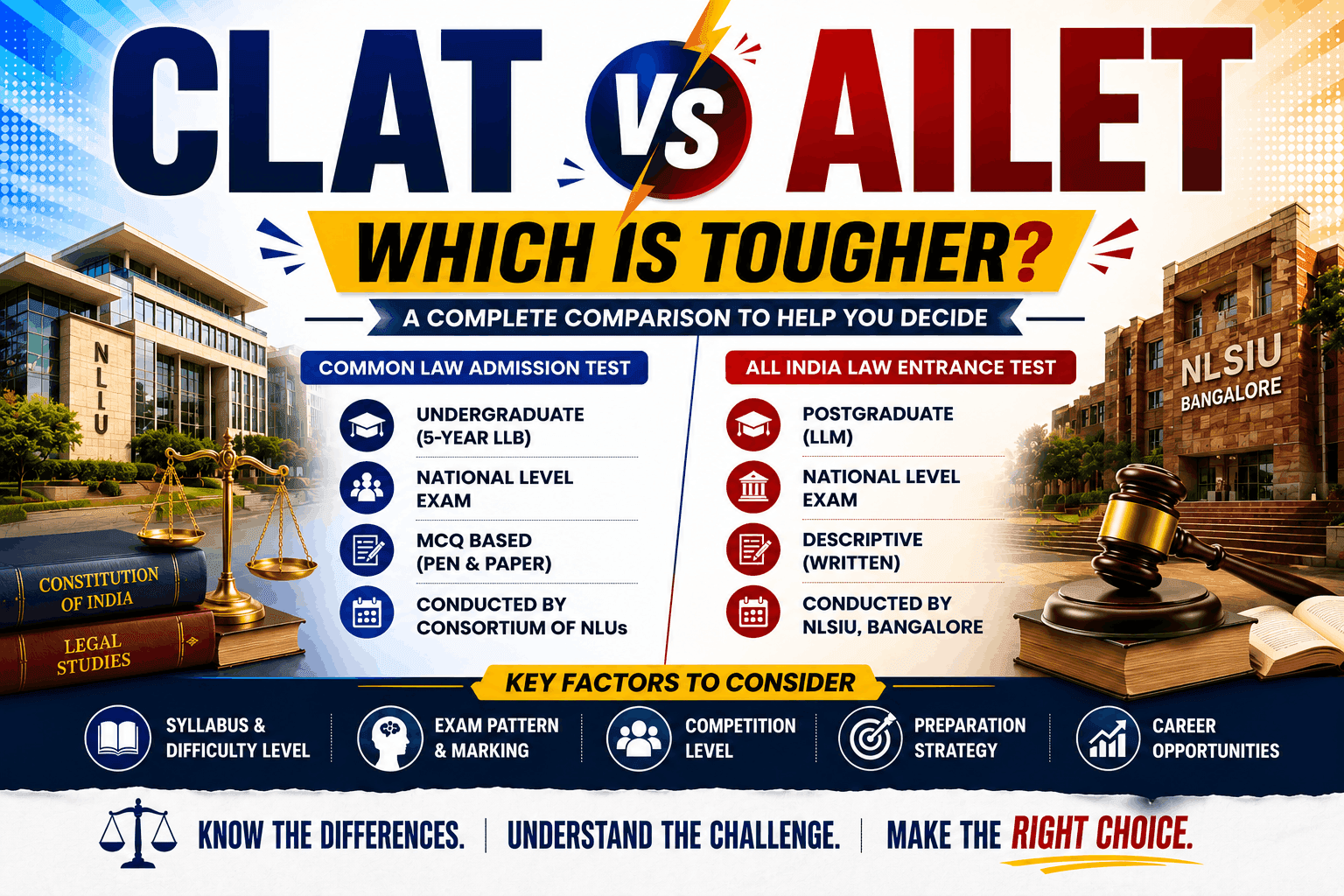
Every law aspirant faces this question at some point: CLAT or AILET — which is more difficult?
The honest answer is that they are hard in different ways. CLAT is harder to rank well in because of the vast competition. AILET is harder to crack simply because of the math—one university, just 80 seats, and over 40,000 students competing for them.
Here is the comparison :-
The Basics First
Before calculating difficulty, lets understand what exactly each exam is.
CLAT — Common Law Admission Test is the centralised entrance for 23 National Law Universities across India. It is conducted by the Consortium of NLUs. Around 70,000–80,000 students appear every year for approximately 2,500 UG seats. CLAT 2027 is scheduled for 6 December 2026.
AILET — All India Law Entrance Test is conducted exclusively by NLU Delhi for admission to its own BA LLB (Hons) programme. NLU Delhi offers 80 UG seats. AILET is a separate exam with a separate pattern, separate paper, and a completely different question philosophy from CLAT.
The two exams lapping in syllabus areas but diverge sharply in what they actually test inside those areas.
CLAT vs AILET: Section-Wise Difficulty at a Glance
Section | CLAT | AILET | Which Is Tougher? |
|---|---|---|---|
English | Dense, literary passages testing inference and tone; no direct vocabulary or grammar questions | Direct grammar, vocabulary, fill-in-the-blanks, and passages; predictable but highly time-pressured | CLAT (conceptually); AILET (speed-wise) |
Current Affairs & GK | Passage-based questions that test reasoning and understanding of events | Direct factual recall of dates, organizations, personalities, and world events | AILET – requires much broader GK preparation |
Legal Reasoning | Principles are provided in the passage; no prior legal knowledge required | Rewards prior legal knowledge, including judgments, constitutional law, and legal maxims | AILET – demands deeper legal preparation |
Logical Reasoning | Passage-based arguments focusing on inference, assumptions, and strengthen/weaken questions | Mix of passages, puzzles, arrangements, syllogisms, and other reasoning types | AILET – wider range of topics to prepare |
Quantitative Techniques | Class 10-level mathematics with emphasis on data interpretation | More calculation-intensive; includes Class 10–12 arithmetic and algebra | AILET – mathematically more challenging |
Can We Prepare for Both Together?
Yes most serious aspirants do. The syllabus overlap is around 70–75%. Here is how a student can prepare for both exams:-
Common preparation (both exams):
Reading well and reading fast — English efficiency is backbone of both exams
A daily current affairs habit — Even 20 minutes a day can help to Crack.
Logical reasoning practice — Arguments and passages, both types
A basic feel for legal concepts — nothing too deep, just strong awareness
AILET-specific additions:
Builds a stronger GK base — AILET asks facts directly, so detailed learning of concepts can make it easy
Go a level deeper in law — big judgements, the Constitution, and legal maxims actually show up here
Train for speed — 36 seconds per question leaves zero room for second-guessing
Solve AILET's old papers — its style is its own, and nothing prepares you for it betterTime split recommendation: If you are targeting both, 70% of your preparation should be CLAT-aligned (it covers the broader base), with 30% specifically targeted at AILET's distinct elements.
Time split recommendation: If you are targeting both exams, 70% of your preparation should be CLAT-aligned (it covers the broader base), with 30% specifically targeted at AILET's logical reasoning elements.
Now - Which is Tougher?
AILET is tougher if you measure by:
Only 80 seats — that's it. CLAT at least gives you 2,500 to fight for
The odds are competative — 2 out of every 1,000 students crack NLU Delhi
Time is everything — barely 36 seconds per question
You need to know more — real legal knowledge and solid GK, not just smart reading
And there's zero safety net — one weak section, and the NLU Delhi dream is over
CLAT is tougher if you measure by:
You're up against 75,000+ students — the absolute crowd makes it tough
The passages aren't easy reads — they're dense, abstract, and need real focus
No section can go wrong — CLAT rewards students who stay steady through all five sections for 2 full hours
One mark = 200 ranks — that's how tight the competition is at the top
CLAT & AILET Coaching 2027 — Admissions Open
Law Prep Tutorial runs India's only truly silo-clean CLAT and AILET preparation — separate batches, separate material, separate mock series for each exam. No diluted combined batches.
With 1,310+ NLU selections over 15 years — including AIR 1 in CLAT 2022, CLAT 2024, and AILET 2024 — our results speak for themselves.
Centres: Hauz Khas · GTB Nagar · Noida · Gurugram · Online (pan-India)
Frequently Asked Questions
Is AILET Harder then CLAT?
AILET is usually considered more competitive than CLAT because there are fewer seats available. Every year, thousands of students apply for admission to NLU Delhi through AILET, making the selection process extremely challenging. In addition to strong reasoning skills, students need good knowledge of current affairs, legal concepts, and time management. While CLAT also has intense competition, AILET often feels tougher because of its limited seats and faster-paced exam pattern.
Can I prepare for both CLAT and AILET simultaneously?
Yes - Many law aspirants prepare for both CLAT & AILET Together because both exams has cover almost same topics , so instead of preparing for different exams students prefer to spend extra time on AILET Preparation on specific areas such as legal awareness, current affairs and speed based practice. With right strategy you can manage both exams.
Which exam should I prioritise — CLAT or AILET?
For many students CLAT 2027 is the primary focus to crack because it opens the door to 23 national law university across india. The good part is that both CLAT & AILET covers the same topic so preparing for one can helps to other.
Which is the best coaching for CLAT and AILET preparation in Delhi?
The right CLAT coaching institute is one that helps students understand concepts clearly, provides regular mock tests, and offers proper guidance throughout the preparation journey. Before joining any institute, students should look at the faculty, study material, batch size, and past results. For students looking for CLAT coaching in Delhi, Law Prep Tutorial is a popular choice because of its experienced mentors, structured study plan, and focus on helping students perform well in the CLAT exam.
How many hours should I study daily for CLAT 2027?
Most successful candidates preparing for CLAT 2027 study consistently for 4–6 hours daily during the early stages and increase their study time closer to the exam. Regular reading, mock tests, current affairs preparation, and sectional practice are essential components of effective CLAT exam preparation.